
We were delighted that this visit to New Orleans allowed us to see two theatre shows in the city; while very different in form, both offer perspectives on and from the city that are worthy of reflection.
We’ve Got a Story to Tell
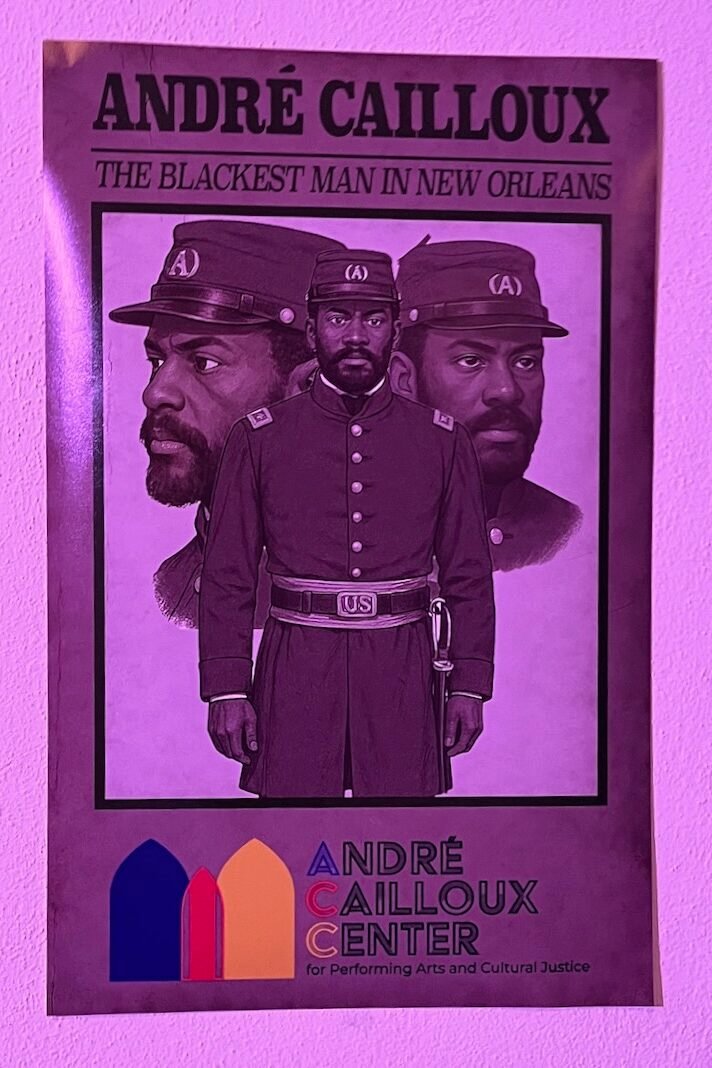
We’ve Got a Story to Tell was written, produced, and directed by Lauren Turner Hines, and performed at the André Cailloux Center for Performing Arts and Cultural Justice, on Bayou Road. The show reflected on the life of Captain André Cailloux, who ‘organized the first Black regiment to fight in combat for the Union Army.’ This was framed as The André Cailloux AR Tour, which reflected on Cailloux, after whom the contemporary arts center is named. It was developed with Black Realities, a programme funding Black creative artists to explore virtual and augmented reality.
The tour began in the foyer, where we were greeted by a performer, Aria Jackson, who welcomed spectators to gather at columns towards the entrance of the building. We were invited to download and test the Black Realities app on our phones. When we pointed our phones to posters in the space, the image of the poster triggered a section of augmented reality ‘videos’, in which a man, Cailloux, welcomed us to the performance.
Jackson addressed us together, beginning a Ghanaian call and response practice that would be key to the performance, and sharing the story of Cailloux. As she did so, she invited us to point our phones at the three images in a painted triptych above the Sanctuary Bar at the back of the foyer. On our phones, each image opened up as if a door, and an augmented reality sequence played out in the middle of the room. We watched the battle in which Cailloux lost his life, and a funeral led by the pastor of the church, subsequently deconsecrated, which is now home to the ACC. We were invited to join together in song, before being led through to the theatre for an alternate aspect of the story.
In the theatre, an actor walked onto the stage, playing the role of Cailloux. We were addressed as recruits for the first Black regiment of the civil war. The actor spoke to us in role as Cailloux, the captain of a then new regiment, and from after his death, reflecting on the few accounts of his contribution to the war, and his fight for justice. After we had been ‘recruited’, Cailloux left the stage, urging us to be ready for training the following morning. As he left the stage, the performance concluded.
This was a performance that set out to address the history of Cailloux as a Black leader in the civil war. Yet, it was also an act of framing the André Cailloux Centre as a site for this Black story, and more broadly as a site for Black stories. We Have a Story To Tell was not a singular work, instead, it creates a frame for future stories of Black leaders. This show invites us to attend to the stories of those who have been important to this place. The decision to share this story through different spaces, through opening up the triptych, through being in call and response, meant that this was a work that was revealed as much through the space as through the work of the actors. The event resisted a sense that theatre needs to happen in a theatre, even in a building that is currently, ostensibly, a theatre.
In part, this engagement with site isn’t new. Theatre companies have engaged with buildings in many ways, and revealed stories through the specifics of a site. Yet, here, in a building that has still only existed as the ACC for three years, this was a work that performed the building as a site for Black stories in the city, on a road that predates the city. From this perspective, the performance recalled André Cailloux’s work in order to activate this place for stories that would be spoken together, where audiences are invited to be a part, rather than to sit quietly. Further, in that the story noted Cailloux’s involvement in a social aid club, the performance threaded the story from the building to continuing contemporary practices in and of the city. We Have a Story to Tell is both an articulation of Cailloux’s story and a statement that there are more stories that will follow. This, as the words of the play argued, is more than just a building, it’s an invitation.’
Primary Trust
In a very different part of town – the Warehouse District – we caught another performance at the Contemporary Arts Centre (CAC). We’ve been lucky to be engaged with the CAC in some form or another since we first came to the city for research in 2018. The then Director, Neil Barclay, was kind enough to host our first major event in the city – a roundtable gathering to explore what we had learnt over the 10 days of that first trip. It was there that we learnt the importance of food at events as a means of extending a welcome to those kind enough to be part of the work. In later trips we have attended artistic exhibitions and events of various kinds, but it wasn’t until this visit that we have been able to see the CAC’s studio theatre in action.
Escaping the bright sun and heat of a Sunday in May, we attended Eboni Booth’s Pulitzer Prize-winning play, Primary Trust. Staged simply, and performed between four actors and an on-stage musician, the work is a meditation on belonging, friendship, identity, loneliness, and loss. The piece took a heightened realist approach to the style of performance, with moments of deep naturalism in the acting coupled with simple, stylized staging, time shifts marked with sound effects and lighting changes, and multi-rolling by two of the four performers.
What was beautiful about the work was its ability to hold these different styles together coherently in the abeyance of the story without losing the emotional resonance at the core of the play. That emotion comes, in the main, from the central character, Kenneth. Played by the utterly compelling Jarrod Smith, 38-year-old Kenneth is still grappling with the emotional trauma of coming home as a 10-year-old to discover his mother dead at home following a battle with cancer. We learn that unable to comprehend the situation and unsure what to do, the young Kenneth dragged his mother into the pantry and stayed there with her for six days.
Following successive absences from school, concern is raised with social services and eventually Kenneth is found by social worker, Bert. A loose friendship is forged between the two before Kenneth is found a place at a home for boys. Dropping him at the home, Bert promises Kenneth he will visit him soon but never returns. Attending to the double trauma of his mother’s death and then perceived abandonment by Bert, Kenneth manifests a new, imaginary version of ‘Bert’ who becomes his best friend and companion from then until we meet him some 28 years later.
The play unfolds then through a series of encounters in which ‘real’ friends rotate out of and into Kenneth’s life. He loses his job when his boss sells up to move out of town for health reasons. He finds friendship with a new server, Corinna, at his favorite bar Wally’s, and new, if complex, professional relationships when he takes a job at Primary Trust bank.
The piece is beautifully gentle, with a marked absence of major, explosive conflict. Instead, the emotion and drama of the work comes from the complex interplay of relationships and their loss or absence.The play hinges, then, on the play of presences and absences in Kenneth’s life: the ever-present trauma and loss of his mother’s death, the loss of identity in losing the only job he ever knew, the present absence of a best friend who turn out to be a figment of his imagination, and the emergence of real friendships from small encounters as he tries to find his way in life.
In a city that stages death so powerfully, proudly and publicly in Jazz Funerals, to stage the trauma of loss in such a quiet, considered, personal way offers a fascinating juxtaposition. Booth’s play stages grief in complex and multi-layered ways that offer the audience a chance to consider the interrelated nature of traumas, and the ways they iterate outwards to interconnect with the mundane and everydayof one’s life and the lives of others.
Mapping theatre spaces in the city
These performances drew attention to the ways in which theatre performances in a place can be considered to be in conversation with one another. Perhaps the performances were always planned to run at similar times, perhaps it was chance. Either way, they remind us of the value of reading connections between the creative practices that unfold in a place. The projects revealed the importance of theatre spaces in New Orleans as critical sites through which to share and experience Black stories in the city. This is particularly critical at the André Cailloux Center, a home for Black theatre in New Orleans. Taken together, the projects speak of the importance of being in a theatre in the city; they invite a mapping of theatre spaces in New Orleans and the stories that play out on there.