We’ve just recorded a new podcast with Zainab Farooqui for Listen: Crisis Response Journal, reflecting on our ongoing work in New Orleans and the ideas developed in our recent book, Performing New Orleans. It was important for us to record this conversation while we were in the city itself, as being present in New Orleans allowed the discussion to be grounded in lived experience, ongoing relationships, and the realities of place.
Rather than treating the book as an endpoint, the recording allowed for a new conversation on what happens when research is developed in dialogue with a city—and tested in dialogue with communities, practitioners and institutions.
The discussion challenges dominant, often neoliberal, understandings of resilience that shift responsibility from systems to individuals. Instead, we explored how resilience is already being practised by artists, cultural organisations and communities, and what emergency managers can learn from this. From Mardi Gras to muraling, from theatre companies delivering food during COVID to everyday street-level creativity, arts practices reveal both how cities absorb shocks and how they live with and manage long-term stresses.
Crucially, the podcast argues for paying artists, consulting meaningfully, and recognising arts organisations as strategic resilience actors in their own right—not simply as delivery mechanisms for existing policy. We also discuss why resilience frameworks need to value qualitative, lived experience alongside metrics, and how infrastructure itself “performs” in people’s daily lives.
For resilience professionals, the message is clear: a whole‑of‑society approach means learning from existing cultural practices, valuing local expertise, and making space for more human, creative, and equitable forms of resilience planning.
We look forward to the podcast going live (and also to CRJ’s book review of Performing New Orleans), thanks Zainab for a fascinating discussion!
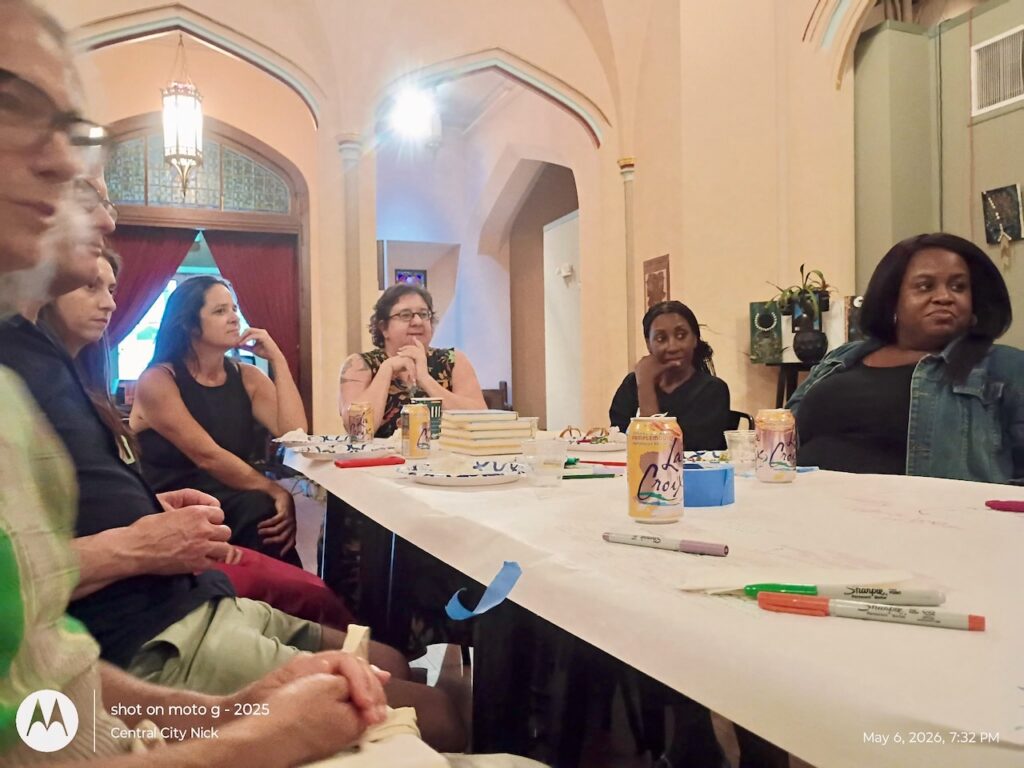
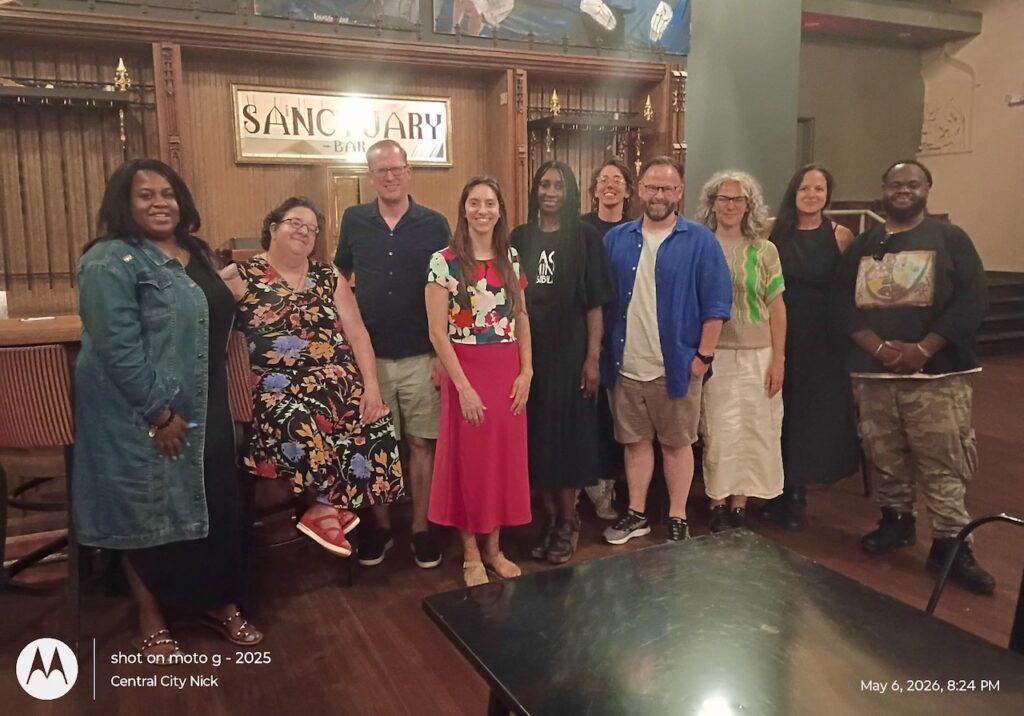
On Wednesday evening, we were in conversation with Lauren Turner Hines at an event hosted by the Gulf South Open School, generously moderated by Professor Amy Lesen. Bringing people together around a table and over food to think collectively about art, theatre, everyday performance, and resilience was an extraordinary treat. In part, this event allowed reflection on Performing New Orleans: Rethinking Resilience in Art and Everyday Life, but it also enabled conversations on the next steps for our research in and beyond the city.
The conversation ranged across artistic, cultural, everyday, and theatrical practices, and the ways these might help surface terms and models of resilience. We spent time reflecting on how stories operate — how they can include or exclude, shape perspectives, and differ from instructive ‘messages’. Rather than aiming for neat conclusions, we were interested in how the arts invite us to spend productive time with complexity: sitting with difficult experiences, questions, contradictions, and uncertainties in order to discover and imagine (im)possibilities for a changed and more equitable world. We also reflected on the potential of terms such as transformation and refamiliarisation to open up new discourses on resilience.
The conversation itself embodied these ideas. It was rich, generous, productively critical, and shaped by everybody around the table. We were grateful to hear from members of the Gulf South Open School and to be in dialogue with people whose thinking is grounded so deeply in this city. It was also a pleasure to connect with colleagues from Civic Studio, an organisation whose work demonstrates what thoughtful civic leadership looks like in New Orleans.
One small but powerful gesture captured the spirit of the evening: Civic Studio’s practice of bringing a box of pens, covering the community table with long sheets of paper, and inviting participants to write and draw as they thought through ideas from the event. These sheets of paper are collected and archived by Civic Studio, irrespective of their condition, where people have been eating throughout, as a record of the community table series.
It was amazing to be sat around a table in a discussion that ran much later than anticipated. Thank you to Gulf South Open School, Amy Lesen, Lauren and colleagues at André Cailloux, Brunel University of London and Southampton University for supporting the event, Civic Studio, and everyone who joined us for creating a space for good food and conversation.
We’re delighted to be contributing to a ‘Community Table’ discussion, hosted by the Gulf South Open School (GSOS) at the André Cailloux Center for Performing Arts and Cultural Justice (ACC) at 6pm. We’ll be speaking with Lauren Turner-Hines, the CEO of the André Cailloux Centre and the discussion will be moderated by Prof. Amy Lesen (Antioch University). We are grateful to GSOS, the ACC, Brunel University of London, and Southampton University for supporting the event. Really looking forward to great conversations on the vital importance of the arts in New Orleans in responding to contemporary challenges. Info below:
Community Table: Rethinking Resilience in Art and Everyday Life
Join us for a conversation between New Orleans arts leader and founder of the The André Cailloux Center for Performing Arts and Cultural Justice, Lauren Turner Hines, and Stuart Andrews and Patrick Duggan, interdisciplinary arts-and-resilience scholar/practitioners from the UK who deeply love and cherish our city.
The exchange will explore cultural and creative practices as approaches to climate and environmental justice. In Stuart and Patrick’s recent book, Performing New Orleans: Rethinking Resilience in Art and Everyday Life (LSU Press, 2025), they explore cultural traditions, civic rituals, and everyday practices and their power for navigating challenges like climate adaptation and resilience. At this community table, we want to open a dialogue for new thinking about how performance and place intersect with sustainability, emergency management, and community knowledge: What creative frameworks for environmental and community leadership might help us imagine futures beyond crisis? The discussion will be moderated by Amy Lesen.
Yesterday marked a necessary start to this period of work in New Orleans: meetings, planning, and re-establishing conversations that have been ongoing—albeit at a distance—for some time.
The morning was spent sketching out the contours of a developing strand of research that builds from earlier work here. As ever, this involved less a sense of beginning anew and more one of returning to, and extending, an existing terrain—thinking through how questions around cultural practice, environmental context, and forms of knowledge exchange might be carried forward through both teaching and prospective funding bids.
Circulating the book locally
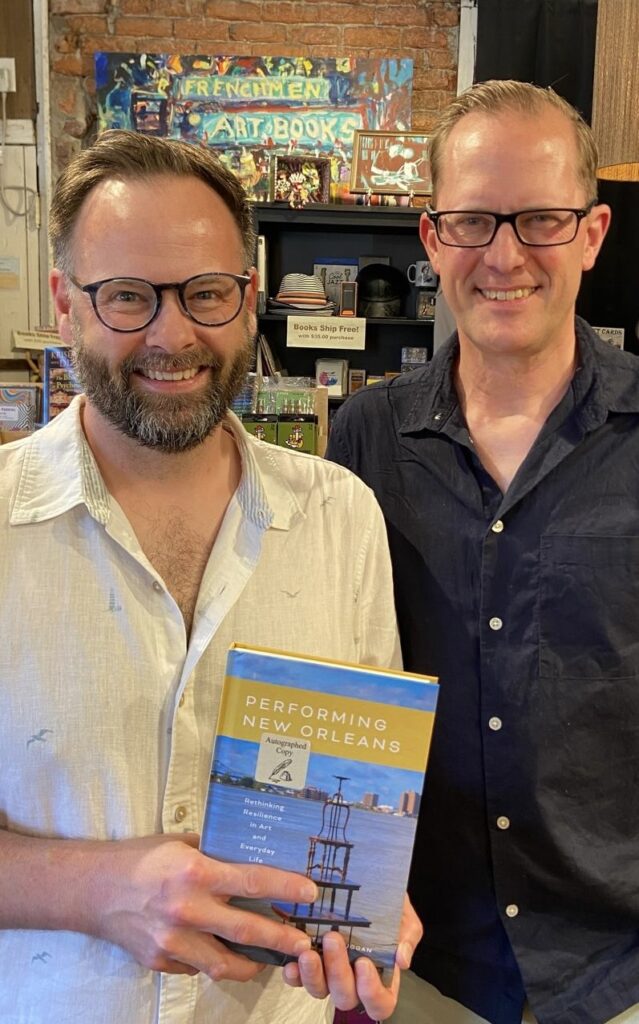
Being back in the city for the first time since Performing New Orleans was published also created space for more informal forms of engagement. We visited a number of the booksellers who have been generous in stocking the book, including Frenchmen Art & Books, where we were invited to sign the final copy on their shelves. A further signing is scheduled later this week at the Historic New Orleans Collection, which will offer another opportunity to situate the book within the local contexts from which it emerged.
Exhibitions and conversations at the CAC
The afternoon took us to the Contemporary Arts Center (CAC), where we spent time with two current exhibitions. The CAC’s Festival/New/Works, part of its 50th anniversary programme, brings together artists working across Louisiana in a deliberately open, cross-disciplinary frame, emphasising practices that are still in formation rather than fully resolved. Rather than a retrospective or survey, it positions contemporary work as something iterative and in motion—a useful reminder of the provisional quality of much of the work we are engaged in here.
Alongside this, we visited Mending Kit, a large-scale, immersive installation by Jan Gilbert and Kathy Randels. Developed in the long wake of Hurricane Katrina, the work draws on Gilbert’s sustained interest in memory, loss, and transition, often using found materials and collaborative processes to explore how personal and collective histories are held and reworked. Installed across the CAC galleries, Mending Kit operates less as a discrete artwork and more as an environment: a space for considering repair—not as restoration to a previous state, but as an ongoing, incomplete practice shaped by community experience and environmental change. The project sits within a wider ecology of works at the CAC that engage questions of water, vulnerability, and adaptation in the region.
Future directions
We were fortunate to be guided through both exhibitions by Jan Gilbert, whose longstanding engagement with the city’s cultural and environmental landscape continues to inform much of our own thinking. The visit also provided an opportunity to meet Raelle Myrick-Hodges, the CAC’s new Executive Director. Our conversation ranged from the book itself to the role the CAC has played—and continues to play—in shaping the broader Performing City Resilience project, including through the support and leadership of previous director Neil Barclay.
Raelle outlined a number of forthcoming priorities for the organisation, including plans to convene a programme of performance work in April 2027 that will bring together practices from New Orleans and beyond. What was particularly notable was the emphasis on creating conditions for exchange—between artists, disciplines, and communities—rather than simply presenting finished work. This resonates strongly with many of the concerns that underpin PCR, and it will be important to continue this conversation as those plans develop.
Reconnecting with collaborators
The day concluded with an extended discussion with long-time collaborators Jan Gilbert and Kevin McCaffrey—an opportunity to reflect on next steps and to situate emerging ideas within a much deeper understanding of the city’s environmental conditions and cultural infrastructures. These conversations remain essential: they ground the project in lived knowledge and help to test assumptions that might otherwise remain abstract.
Extending the network
Among other things, we were reminded of an earlier connection made in 2023 at Docville Farm with what was then the Deputy Director of the Jean Lafitte National Historical Park and Preserve. Now serving as Superintendent, we are delighted to be meeting later this week to discuss our developing interest in arts-led approaches to environmental leadership—a conversation that feels both timely and necessary given the broader trajectory of the project.
Along the way, the smaller markers of progress also accumulated: three signed copies of the book (for a local bookseller, a local culture journalist, and the CAC’s new director), and the confirmation of meetings that may open up more sustained collaborations around environmental research in the city and its surrounding landscapes.
Taken together, it was a productive way to begin the work of the trip—less defined by any single outcome than by the careful reactivation of relationships, ideas, and shared points of reference that will shape what follows.
Although we’ve been coming to New Orleans pretty regularly since 2018, we’ve not had much opportunity to engage with musical performances when here. This may seem a little odd considering the city is so famous for its musical life, and while we have of course caught the occasional live set or two this has often been though happenstance rather than planning. In part this is because our work in the city has been less focused on this form of cultural production than on other forms of performance. Nevertheless, music remains the lifeblood of New Orleans’ culture, with the New Orleans Jazz and Heritage Festival an annual cultural anchor point in the city.
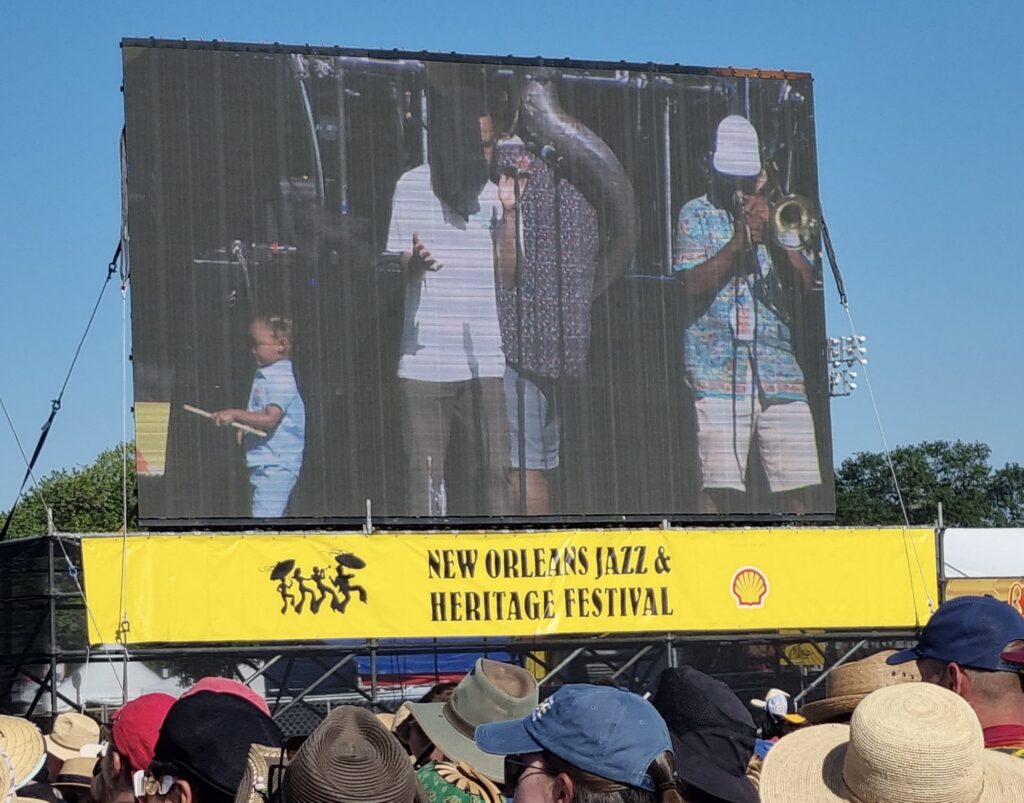
With that in mind, it was something of a happy coincidence when we realized this trip to the city might coincide with the last weekend of the festival, and a delight to finally make it through the gates for the last day. Jetlag aside, it was an unforgettable experience; and while attending wasn’t strictly work, being at the festival affords an opportunity to reflect on some of our findings about the COVID-19 iteration of Jazz Fest from Performing New Orleans: Rethinking Resilience in Art and Everyday Life.
Social and economic contribution
While Mardi Gras is undoubtedly the economic powerhouse of the city’s annual tourism budget, generating approximately $890M each year, Jazz Fest is the city’s largest ticketed cultural event with somewhere between 400 – 500,000 visitors across its two weeks, and somewhere in the region of $400M generated. Inaugurated in 1970, the festival was a deliberate attempt to bring visitors to New Orleans from across the US and internationally. While there isn’t a clean source of data on attendance, best estimates suggest the festival audience is in the region of 40% local to 60% out-of-towners like us. So Jazz Fest is less locally/regionally oriented than much of Mardi Gras (chapters one and five of the book discuss this) but nonetheless an important cultural performance to residents of the place both socially and economically.
From a Performing City Resilience perspective, our interest here is less in any analysis of the music itself (indeed we are not musicologists) but rather to think about the event performance more broadly. One of the key parts of the COVID-19 impacted iteration of the festival was the way that its digital incarnation afforded a structure within which practices of community marking were enabled within the familiar structure of the two week(end) programme. People from around the world ‘came together’ through costuming, sign making, cooking and cocktail making, and the digital sharing of these. While these are small acts, their collective digital performance offered opportunities for community building and joy that, we argue in the book, were vital both to individuals experiencing physical distancing and possible isolation and a globally available performance of New Orleans cultural identity.
A space for all?
What was interesting to observe yesterday, was the ways in which these markers of identity – that is the ‘community’ of Jazz Festers, so to speak – were on display across the festival site. This included the costuming, sign making, flag waving and consumption of food (with locals offering advice readily about the ‘best’ dishes to look for!), but also markers of long term participation through the wearing of pervious years’ hats, t-shirts and limited edition festival shirt and shorts suits that are produced annually.
While children and families featured in the online version of the festival in 2020, the genuinely intergenerational nature of it wasn’t apparent to us until we observed it in person. From babies and toddlers in prams or being carried, to parties of middle-aged friends dancing, to older men and women snoozing on folding chairs, the festival establishes itself as a multi-generational space. Not only that but children feature heavily on the stages too, as dancers or offering additional percussion support, or indeed as the starring vocals in part of Kermit Ruffins’ set.
These things afforded a sense of collective practice, a sense of coming together to mark a repeated shared experience. That the event matters to New Orleans economically seems, in the embodied encounter with it at least, less important (less interesting) than the performance of New Orleanian identities that unfolds across the site. As local film maker and oral historian Kevin McCaffrey put it to us yesterday: “there are people I only see at Jazz Fest”… so, the annual encounter with the event performance of the New Orleans Jazz and Heritage Festival matters, from individual to the city-wide scales.
Where next?
There is more thinking and research to be done here, including:
how Jazz Fest can be understood in the wider tourism industry of New Orleans (for instance in terms of location of event and distribution of tourists, or forms of tourist behavior)
how individual artists and bands articulated their position in the festival programme and what this say about the politics of the event itself and of the music economy/ecology in the city more broadly, such as Kermit Ruffins making a number of jokes about being scheduled at the same time as Trombone Shorty, or Rebirth Brass Band referencing Shorty’s 40th birthday, or Jason Marsalis repeated referencing of his family’s musical lineage (the son of legendary pianist Ellis Marsalis Jr.) and positioning (brothers Branford, Wynton, and Delfeayo are all successful jazz musicians, while Wynton’s picture was hanging in the Jazz tent during Jason’s set
how we might understand the role, function and politics of the festival’s site, Fair Grounds Race Course & Slots, in wider city discourse about place and place identity, and it’s role in disaster recover work
the politics of corporate sponsorship at Jazz Fest, and potential loss thereof
Arts, Resilience, and Environmental Leadership in New Orleans
This spring, we’re back in New Orleans for our first visit since publishing Performing New Orleans: Rethinking Resilience in Art and Everyday Life. While this book sets out key findings from our research across 2017-2025, its publication offers a critical opportunity to begin new conversations with the city.
Following our practice in previous research visits to the city, this trip is primarily focused on understanding the ways in which our work can be productively placed in dialogue with practices and strategies in the city. Too often, this ‘checking in’ doesn’t fit neatly into a research process and yet it has become critical to our practice. It is not enough to write about a city and imagine that the work is done, for that risks suggesting that the city is somehow done. If we’re to make good on the last line of our book,that it is impossible to be done with New Orleans, then it is essential to go back.
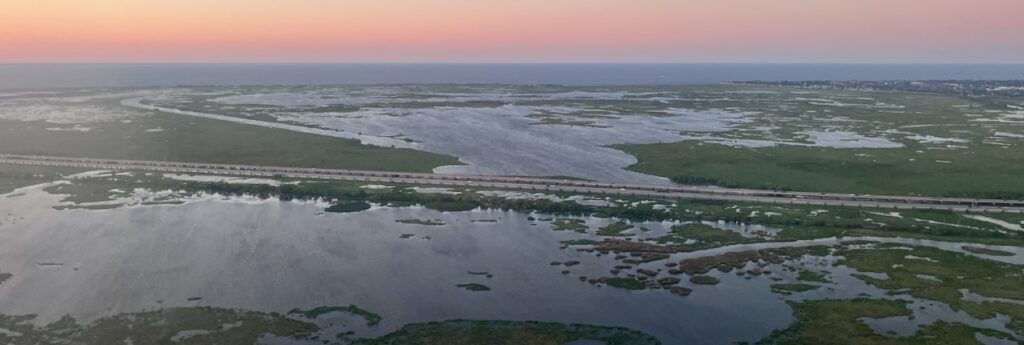
This time, we are particularly focused on thinking through practices of environmental leadership in New Orleans, and engaging in the city by way of thinking through the relation of the city to the Delta. Environmental management is not neat in any city, and we’re keen to understand more about the ways in which our approach intersects with the approaches that organisations and individuals take to practise environmental resilience in New Orleans and southeastern Louisiana.
This trip comprises a series of events and activities that focus on the book and potential next steps for Performing City Resilience in the city:
Participating in a Community Table event with Lauren Turner-Hines, facilitated by Prof Amy Lesen for the Gulf South Open School at the André Cailloux Centre for Performing Arts and Cultural Justice. We’re grateful to the School for this invitation, to the André Cailloux Centre for holding this discussion, and to Brunel University of London and Southampton University for supporting the event.
Contributing to a podcast for the Listen: Crisis Response journal podcast.
Meeting with colleagues from from Anitioch, Dillard, Tulane, New Orleans, and Xavier universities. As part of these conversations, we are exploring potential institutional collaborations including funding bid development, collaborative online international learning (COIL) opportunities.
Meeting with curators, artists, and performance makers in the city, whose work we consider in the book, as well as meetings with arts leaders in the city with whom we have not yet worked and hope to develop new relationships, to further explore the potential impact has had so far, and scope new opportunities.
Attending contemporary arts events, including a new AR work at the André Cailloux Centre, a performance piece by Eboni Booth at the Contemporary Arts Centre exploring loneliness, isolation, and connection in the contemporary world, and catching the last day of Jazz Fest, a key arts event in the New Orleans calendar, and one that is particularly relevant this year in the context of the significant rainfall which led to reworking of the festival programme. We’re fascinated to experience the festival in person for the first time, having analysed its digital COVID incarnation in the book. Alongside specific events and exhibitions, we will also chart changes to places in the city and attend to the practise of performing environment in the context of change at the Jean Lafitte National Park and Historical Preserve.
Rethinking art and local resilience at GLOBESEC, Prague
Later this month, Performing City Resilience returns to the GLOBESEC annual forum, held in Prague. Stuart Andrews will be presenting on an international panel chaired by Tom DiMaria, Director of Arts for All. The panel will reflect on the ways in which the arts can speak to the extraordinary challenges that are faced by people in specific places. We’re honoured to be contributing to this vital forum on defence and democracy.
Public Lecture: Performance and Just Resilience at Brunel University of London: Have you ever seen the rain?
In May, Stuart Andrews will reflect on Performing New Orleans in a public panel lecture, together with contributions from Shona Patterson and Anamika Twyman-Ghoshal. These three scholars will explore how can arts and cultural practices can reimagine contemporary challenges and build justice into strategies and practices of resilience. The public lecture is part of Brunel Creates, a new arts festival at Brunel that marks it’s 60th anniversary.