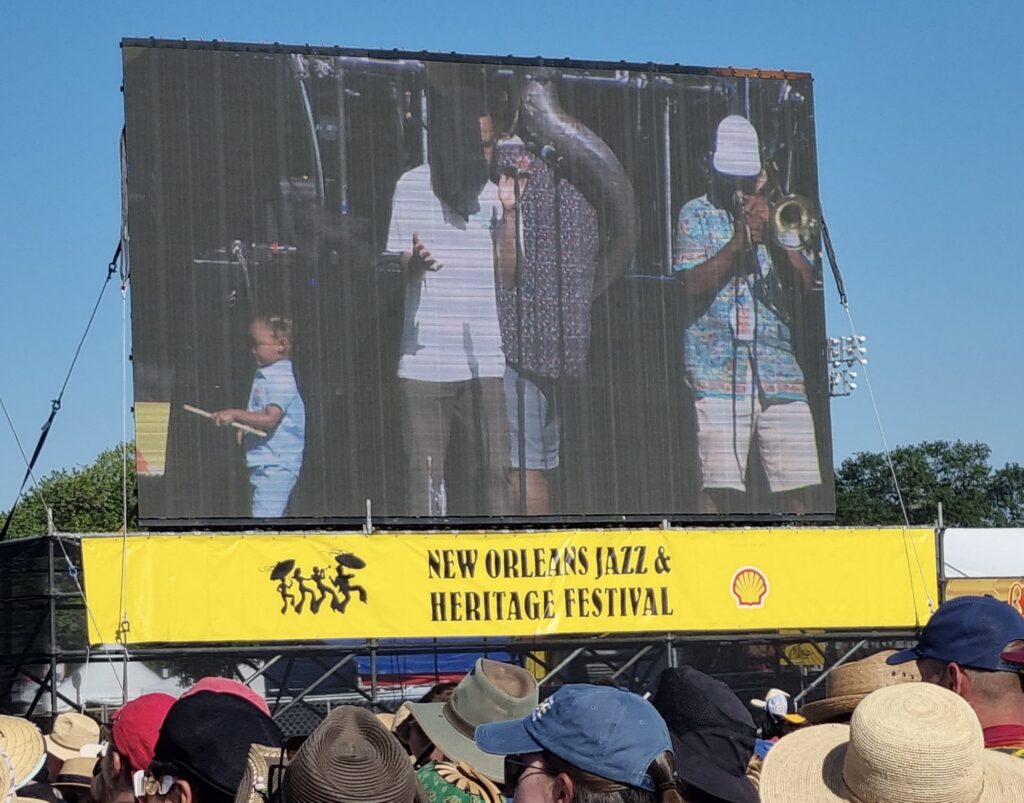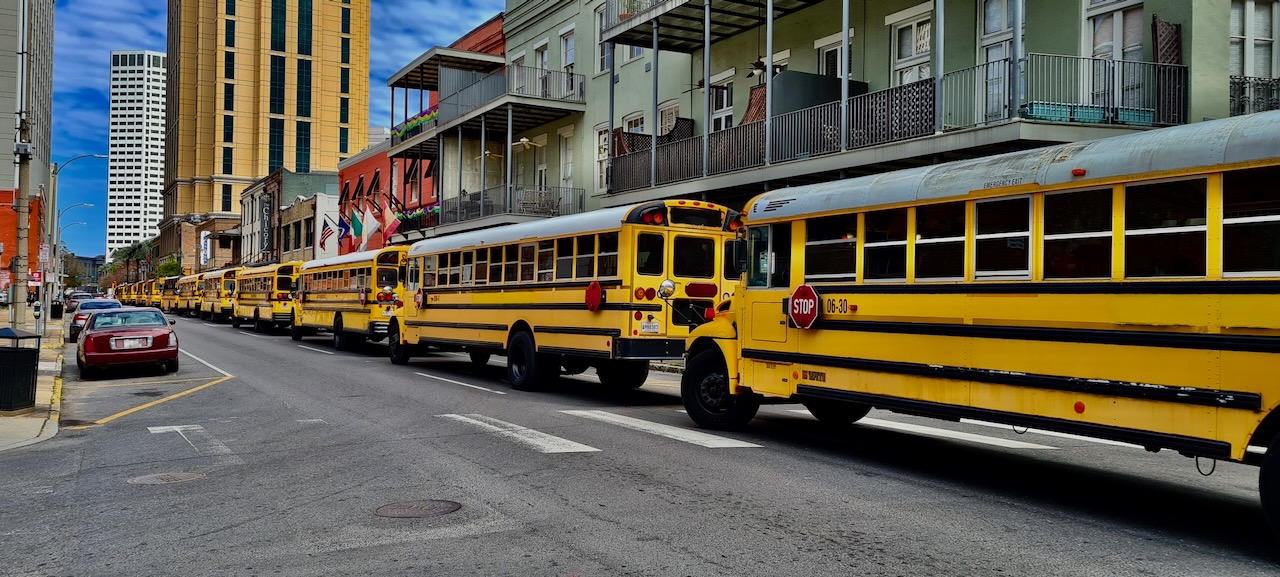

Although we’ve been coming to New Orleans pretty regularly since 2018, we’ve not had much opportunity to engage with musical performances when here. This may seem a little odd considering the city is so famous for its musical life, and while we have of course caught the occasional live set or two this has often been though happenstance rather than planning. In part this is because our work in the city has been less focused on this form of cultural production than on other forms of performance. Nevertheless, music remains the lifeblood of New Orleans’ culture, with the New Orleans Jazz and Heritage Festival an annual cultural anchor point in the city.
With that in mind, it was something of a happy coincidence when we realized this trip to the city might coincide with the last weekend of the festival, and a delight to finally make it through the gates for the last day. Jetlag aside, it was an unforgettable experience; and while attending wasn’t strictly work, being at the festival affords an opportunity to reflect on some of our findings about the COVID-19 iteration of Jazz Fest from Performing New Orleans: Rethinking Resilience in Art and Everyday Life.
Social and economic contribution
While Mardi Gras is undoubtedly the economic powerhouse of the city’s annual tourism budget, generating approximately $890M each year, Jazz Fest is the city’s largest ticketed cultural event with somewhere between 400 – 500,000 visitors across its two weeks, and somewhere in the region of $400M generated. Inaugurated in 1970, the festival was a deliberate attempt to bring visitors to New Orleans from across the US and internationally. While there isn’t a clean source of data on attendance, best estimates suggest the festival audience is in the region of 40% local to 60% out-of-towners like us. So Jazz Fest is less locally/regionally oriented than much of Mardi Gras (chapters one and five of the book discuss this) but nonetheless an important cultural performance to residents of the place both socially and economically.
From a Performing City Resilience perspective, our interest here is less in any analysis of the music itself (indeed we are not musicologists) but rather to think about the event performance more broadly. One of the key parts of the COVID-19 impacted iteration of the festival was the way that its digital incarnation afforded a structure within which practices of community marking were enabled within the familiar structure of the two week(end) programme. People from around the world ‘came together’ through costuming, sign making, cooking and cocktail making, and the digital sharing of these. While these are small acts, their collective digital performance offered opportunities for community building and joy that, we argue in the book, were vital both to individuals experiencing physical distancing and possible isolation and a globally available performance of New Orleans cultural identity.
A space for all?
What was interesting to observe yesterday, was the ways in which these markers of identity – that is the ‘community’ of Jazz Festers, so to speak – were on display across the festival site. This included the costuming, sign making, flag waving and consumption of food (with locals offering advice readily about the ‘best’ dishes to look for!), but also markers of long term participation through the wearing of pervious years’ hats, t-shirts and limited edition festival shirt and shorts suits that are produced annually.
While children and families featured in the online version of the festival in 2020, the genuinely intergenerational nature of it wasn’t apparent to us until we observed it in person. From babies and toddlers in prams or being carried, to parties of middle-aged friends dancing, to older men and women snoozing on folding chairs, the festival establishes itself as a multi-generational space. Not only that but children feature heavily on the stages too, as dancers or offering additional percussion support, or indeed as the starring vocals in part of Kermit Ruffins’ set.
These things afforded a sense of collective practice, a sense of coming together to mark a repeated shared experience. That the event matters to New Orleans economically seems, in the embodied encounter with it at least, less important (less interesting) than the performance of New Orleanian identities that unfolds across the site. As local film maker and oral historian Kevin McCaffrey put it to us yesterday: “there are people I only see at Jazz Fest”… so, the annual encounter with the event performance of the New Orleans Jazz and Heritage Festival matters, from individual to the city-wide scales.
Where next?
There is more thinking and research to be done here, including:
- how Jazz Fest can be understood in the wider tourism industry of New Orleans (for instance in terms of location of event and distribution of tourists, or forms of tourist behavior)
- how individual artists and bands articulated their position in the festival programme and what this say about the politics of the event itself and of the music economy/ecology in the city more broadly, such as Kermit Ruffins making a number of jokes about being scheduled at the same time as Trombone Shorty, or Rebirth Brass Band referencing Shorty’s 40th birthday, or Jason Marsalis repeated referencing of his family’s musical lineage (the son of legendary pianist Ellis Marsalis Jr.) and positioning (brothers Branford, Wynton, and Delfeayo are all successful jazz musicians, while Wynton’s picture was hanging in the Jazz tent during Jason’s set
- how we might understand the role, function and politics of the festival’s site, Fair Grounds Race Course & Slots, in wider city discourse about place and place identity, and it’s role in disaster recover work
- the politics of corporate sponsorship at Jazz Fest, and potential loss thereof