Yesterday marked a necessary start to this period of work in New Orleans: meetings, planning, and re-establishing conversations that have been ongoing—albeit at a distance—for some time.
The morning was spent sketching out the contours of a developing strand of research that builds from earlier work here. As ever, this involved less a sense of beginning anew and more one of returning to, and extending, an existing terrain—thinking through how questions around cultural practice, environmental context, and forms of knowledge exchange might be carried forward through both teaching and prospective funding bids.
Circulating the book locally
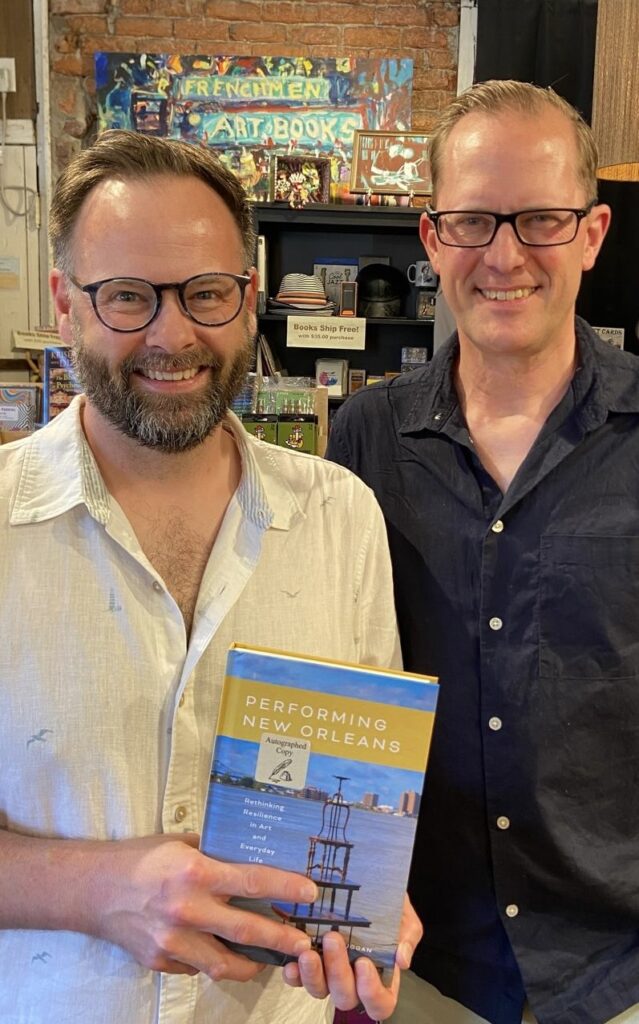
Being back in the city for the first time since Performing New Orleans was published also created space for more informal forms of engagement. We visited a number of the booksellers who have been generous in stocking the book, including Frenchmen Art & Books, where we were invited to sign the final copy on their shelves. A further signing is scheduled later this week at the Historic New Orleans Collection, which will offer another opportunity to situate the book within the local contexts from which it emerged.
Exhibitions and conversations at the CAC
The afternoon took us to the Contemporary Arts Center (CAC), where we spent time with two current exhibitions. The CAC’s Festival/New/Works, part of its 50th anniversary programme, brings together artists working across Louisiana in a deliberately open, cross-disciplinary frame, emphasising practices that are still in formation rather than fully resolved. Rather than a retrospective or survey, it positions contemporary work as something iterative and in motion—a useful reminder of the provisional quality of much of the work we are engaged in here.
Alongside this, we visited Mending Kit, a large-scale, immersive installation by Jan Gilbert and Kathy Randels. Developed in the long wake of Hurricane Katrina, the work draws on Gilbert’s sustained interest in memory, loss, and transition, often using found materials and collaborative processes to explore how personal and collective histories are held and reworked. Installed across the CAC galleries, Mending Kit operates less as a discrete artwork and more as an environment: a space for considering repair—not as restoration to a previous state, but as an ongoing, incomplete practice shaped by community experience and environmental change. The project sits within a wider ecology of works at the CAC that engage questions of water, vulnerability, and adaptation in the region.
Future directions
We were fortunate to be guided through both exhibitions by Jan Gilbert, whose longstanding engagement with the city’s cultural and environmental landscape continues to inform much of our own thinking. The visit also provided an opportunity to meet Raelle Myrick-Hodges, the CAC’s new Executive Director. Our conversation ranged from the book itself to the role the CAC has played—and continues to play—in shaping the broader Performing City Resilience project, including through the support and leadership of previous director Neil Barclay.
Raelle outlined a number of forthcoming priorities for the organisation, including plans to convene a programme of performance work in April 2027 that will bring together practices from New Orleans and beyond. What was particularly notable was the emphasis on creating conditions for exchange—between artists, disciplines, and communities—rather than simply presenting finished work. This resonates strongly with many of the concerns that underpin PCR, and it will be important to continue this conversation as those plans develop.
Reconnecting with collaborators
The day concluded with an extended discussion with long-time collaborators Jan Gilbert and Kevin McCaffrey—an opportunity to reflect on next steps and to situate emerging ideas within a much deeper understanding of the city’s environmental conditions and cultural infrastructures. These conversations remain essential: they ground the project in lived knowledge and help to test assumptions that might otherwise remain abstract.
Extending the network
Among other things, we were reminded of an earlier connection made in 2023 at Docville Farm with what was then the Deputy Director of the Jean Lafitte National Historical Park and Preserve. Now serving as Superintendent, we are delighted to be meeting later this week to discuss our developing interest in arts-led approaches to environmental leadership—a conversation that feels both timely and necessary given the broader trajectory of the project.
Along the way, the smaller markers of progress also accumulated: three signed copies of the book (for a local bookseller, a local culture journalist, and the CAC’s new director), and the confirmation of meetings that may open up more sustained collaborations around environmental research in the city and its surrounding landscapes.
Taken together, it was a productive way to begin the work of the trip—less defined by any single outcome than by the careful reactivation of relationships, ideas, and shared points of reference that will shape what follows.